Hito Steyerl

Hito Steyerl plays with cinematic techniques, learned codes governing our understanding of film and vision in film. This film How not to be Seen references Monty Python’s “how to be invisible”. While I like the work, i also think the original is much smarter, and reminds me of the amazing Monty Python sketches that use necessity and expectation to create humour and a jolt of expectations. My favourite clip is of Arthur running to the Castle in the Holy Grail - timing!

Hito Steyerl, How Not to be Seen: A Fucking Didactic Educational .MOV File, 2013
Hito Steyerl, How Not to be Seen: A Fucking Didactic Educational .MOV File, 2013

HD video projection (color, sound, 14 minutes), architectural environment, dimensions variable.
The German artist Hito Steyerl addresses the way digital images are created, shared and archived. Her film 'How Not to Be Seen: A Fucking Didactic Educational .MOV File' (2013) takes the form of an instructional video which flips playfully between 'real world' footage and digital recreations.
https://www.facebook.com/500kshow

Bill Viola

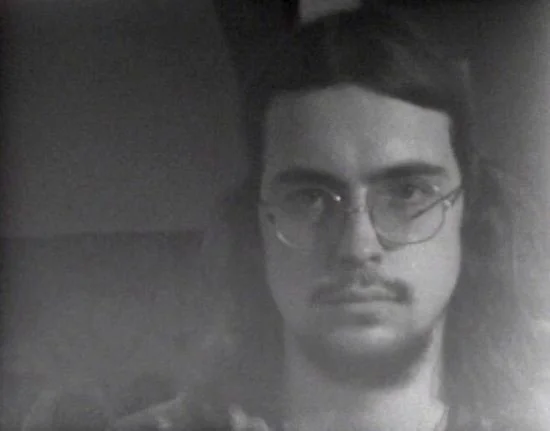
After watching this excerpt in this interview of Tape I, 1972 - mirror, reflection, self, and his other works reflecting on reflection. I really like this play on expectation and reflection that the simplicity of the mirror brings, and although i think the screaming part is a bit earnest, but I guess it was the seventies. The ending is really great too, using the self to physically stop the tape, it really works in a great way.

When video artist Bill Viola was 6 years old he fell into a lake, all the way to the bottom, to a place which seemed like paradise. "There's more than just the surface of life." Viola explains. "The real things are under the surface". American Bill Viola (born 1951) is a pioneer in video art. In this interview, Viola talks about his development as an artist and his most important breakthroughs. As a child Bill Viola felt that the world inside his head was more real than the outside word. Viola discovered video in 1969. The blue light from the first camera he experienced reminded him of the water in that beautiful lake he almost died in when he was 6. The first video piece Viola did on his own was "Tape I" from 1972, when he was still at university. Viola replaced the university art theories with his own secret underground path, through Islamic mystics, to Buddhism, to Christianity and finally to St John of the Cross. It was a very liberating experience for him, when he first started calling his artworks what they actually were to him. Viola once felt that home videos should be kept separate to his artwork, but the sorrow of his mother's death, and the difficulty of understanding this transition from life to "disappearance", slowly changed his point of view. He realized that things could not be kept separate. Viola now sees the cameras as keepers of the soul, he explains. The medium holds onto life, a kind of understanding of feelings, keeping them alive. Bill Viola was interviewed by Christian Lund, Louisiana Museum of Modern Art, in London, 2011. Camera: Marie Friis Grading: Honey Biba Beckerlee. Edited by Martin Kogi Copyright: Louisiana Channel, Louisiana Museum of Modern Art. Meet more artists at http://channel.louisiana.dk/ Louisiana Channel is a non-profit video channel for the Internet launched by the Louisiana Museum of Modern Art in November 2012. Each week Louisiana Channel will publish videos about and with artists in visual art, literature, architecture, design etc. Read more: http://channel.louisiana.dk/about Supported by Nordea-fonden.
TapeI_bill Viola.jpg

Robert Smithson

Robert Smithson’s notions of time, and in particular his views of cinematic time and experience. Ideas of the loop and time constructs in cinema “Repetition creates order” and “Temporal continuity conceals the discrete structure of illusion” while also the immersion of memory and the viewing/viewer experience, “we remember cinema as being in it, not of watching a screen”  are observations that are helping to rethink and develop my ideas of viewer experience in relation to cinema.

_smithsonYucatan-mirror-displacements-7.jpg
Robert Smithson Spiral Jetty film 1970 Origine 32 minutes color. Il est présenté ici des extraits du film réalisé par Robert Smithson Remerciements à Dwan Virginia Dwan Gallery, & Douglas Noël, Directeur Ace Galerie. More informations : http://www.robertsmithson.com/films/txt/spiral.html http://www.blogg.org/blog-56679-billet-robert_smithson-1293155.html http://pointopoint.blogg.org/
amarillo_300c.jpg

Pierre Huyghe

Pierre Huyghe’s early experiments, firstly with the opening up of time and creating an “open present” (in works such as his billboard series in 1994 and Trajet 1992) to his development of non-linearity in cinematic time and delving into “a time beyond screen-time” (ie. The Third Memory 1999-2000, L’Ellipse 1998) has influenced me to rethink time as fixed/objective and has opened up the possibilities of time/duration/experience as subjective and malleable. 

His ideas on time:

  1. The time of the market (working time - encompassing the relation between representations and historiography),

  2. The time of duration - subjective. Duration dilates and expands time, with no respect to the calendar or clock. Its presence maintains the import of subjective differentiations that intrude on distinctions between now and then. The attention to duration disables the homogenisation of time codes, leading to the production of mirrors, double and ghosts.

  3. The time of the image - now more crucial to consider the image in time. This tactic encounters the amnesia of instant history or “presentism” by recognizing that there is time beyond screen time 


Serpentine-Gallery-Pierre-Huyghe-1.jpg
Pierre Huyghe Chantier Barbès-Rochechouart Billboard, Paris 1994. (Part of his billboard series)

Pierre Huyghe Chantier Barbès-Rochechouart Billboard, Paris 1994. (Part of his billboard series)